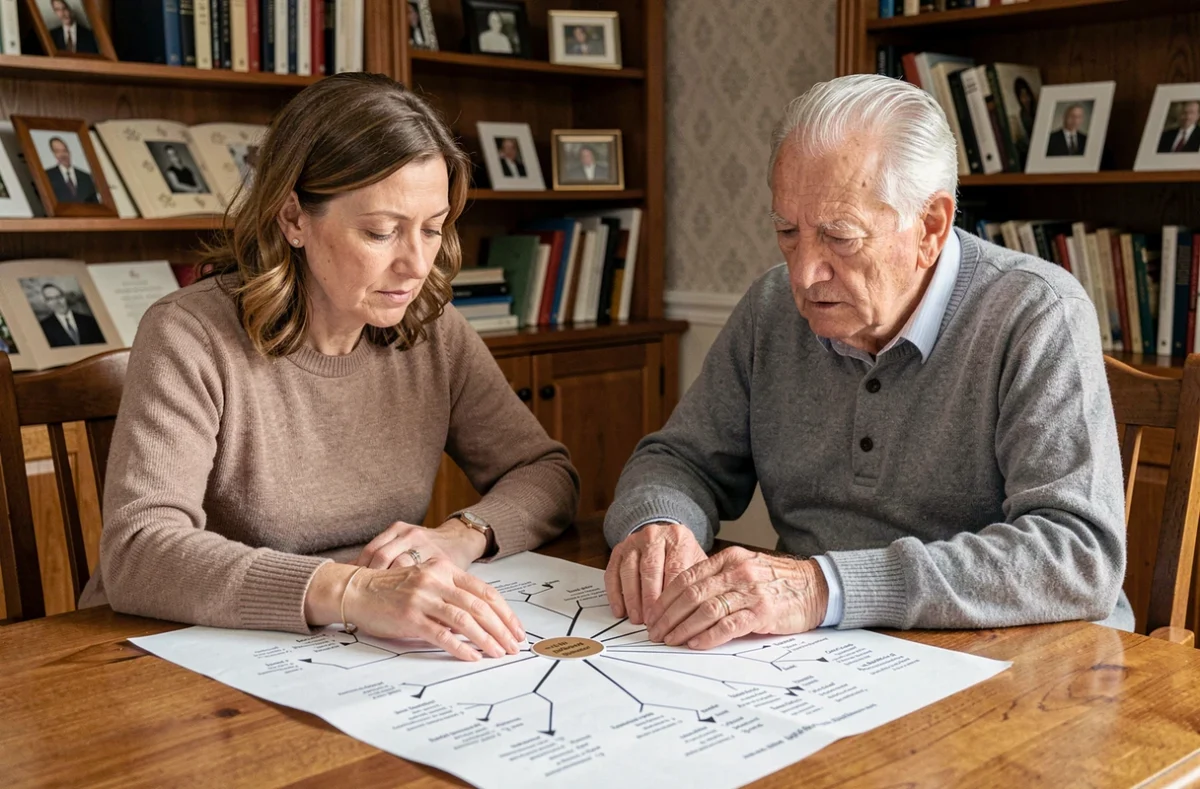
Decoding family ties first requires untangling the threads of heredity, an intuitive quest for the subtle and complex links that weave our family history. Next, one must seek evidence to validate our lineage, a methodical investigative task in archives, official documents, and family memories. In this effort, creating a visual family tree proves to be a valuable tool, a living sculpture of our ancestry. But the exploration doesn’t stop there. Beyond the branches and leaves of this tree lie the interpretations and meanings of our family heritage, an invaluable wealth to understand and cherish.
Untangling the Threads of Heredity: Understanding Family Ties
Heredity is a fascinating concept that has captivated humanity for centuries. Scientists have devoted countless hours to research to understand how traits are passed down from generation to generation. The decoded family DNA has proven to be a major key in this quest for understanding.
Modern science has made significant strides in deciphering the complex mystery of human heredity. One of the most significant discoveries is undoubtedly the double helix structure of DNA, revealed by James Watson and Francis Crick in 19This discovery established that our genetic heritage is stored in the form of a chemical code in our cells—a true instruction manual for building and maintaining every unique aspect of our body.
Now let’s talk about the direct link between this genetic instruction manual and heredity. Each person possesses about 20,000 to 25,000 genes that interact together to form our unique individuality: eye color, hair texture, height, etc. These genes are inherited directly from our parents: you receive a complete copy (or “set”) of the parental genetic code, thus creating your own exclusive combination.
But how are these unique collections created? The answer lies in how sex cells (sperm and ova) are formed when a process called meiosis occurs.
In Search of Evidence: Methods to Validate Your Lineage
Genealogy, the art of exploring one’s past, is a passion that brings us closer to our history and forges our identity. Yet, validating your lineage can prove to be a real challenge without the right approach. Authenticating the data collected during your research is crucial to ensuring the integrity of your family tree. Indeed, it is not uncommon for errors to creep into historical documents or for certain information to be omitted.
To begin the process, collecting reliable information from multiple sources is essential. Parish or municipal records are often a goldmine when it comes to births, marriages, and deaths, while censuses can provide valuable details about the family and professional environment of our ancestors.
After gathering these preliminary elements, cross-referencing information can help identify errors or inconsistencies in different sources. This step should not be overlooked as it not only establishes the validity of each piece of data but also uncovers increasingly precise leads on the individual journey of each family lineage member.
Next comes the crucial step: thorough examination of original documents. This often involves a trip to the local or national archives where they are kept.
Shaping the Tree: Creating Your Visual Genealogy
Creating a family tree is an exciting endeavor that allows you to visualize family history and its various branches. This exploration of the past offers unexpected discoveries, sometimes surprising, but always enriching. It is a valuable tool for understanding where we come from, the connections that bind us to our ancestors, and how they have influenced who we are today.
What you need to know is that creating a family tree requires thorough research. It involves gathering all available documents: birth certificates, marriage and death certificates, old photos, or even handwritten letters. These family artifacts are clues for tracing back through time.
Once this preliminary phase is complete, the actual construction can begin; there are various ways to do this—through specialized genealogy software or simply with paper and pencil. You typically start with yourself at the bottom of the diagram and then gradually move up to parents, grandparents, etc., indicating each member with their full name as well as their respective birth and death dates.
There are several possible formats: vertical tree (ascending or descending), horizontal… Each has its particularity depending on what you wish to highlight in your family history.
The visual aspect also plays a significant role in the final aesthetic: with different colors for each family branch, for example, or by adding photos of each person.
Beyond the Branches: Interpretation and Meaning of Your Family Heritage
Family heritage is more than just the transmission of material goods. It is a legacy filled with values, stories, and experiences that shape our identity and influence our present choices. Interpreting family legacies: a complex but extremely rewarding task that gives each of us the opportunity to study our roots to better understand our present.
Throughout the process, we discover that the past has much to say to the present. It speaks through legendary family tales, honorable ancestral history, or even through precious objects passed down from generation to generation in the family. These elements are like missing pieces in a puzzle that only the interpreter, meaning each individual member of the family lineage, can correctly assemble to have a complete picture.
Sometimes, it is the family traditions rooted over time that play a decisive role in shedding light on certain traits specific to current behaviors. Understanding the origin of these customs often allows for deep introspection leading to better personal understanding as well as strengthening family ties.
Archives such as old letters and yellowed photos also speak to the present with a silent but powerful voice. They tell not only touching personal stories but also offer the broader historical context in which these stories were lived.