Screen regulation engages families’ attention, but it masks a more structural issue: the ability of parents to adjust their educational practices to the developmental signals of the child, rather than to generic recipes. Supporting parents daily in their children’s education requires going beyond lists of good practices to delve into the details of the mechanisms that make a difference.
Parental control on screens: what the regulations require since 2024
Since July 13, 2024, every connected device sold in France must include a parental control system that can be activated from the first use at no additional cost. This obligation stems from the law of March 2, 2022, and the decree of July 11, 2023.
Parental control is now a regulatory requirement, not a comfort option. For parents, this means that the tool is already present on the phone, tablet, or console: it just needs to be activated during the initial setup.
We recommend that families systematically check the settings of each device upon purchase, including connected objects that are often overlooked (watches, speakers). Establishing a technical framework early on significantly reduces daily negotiations about access to content. Many resources compiled by parents on Le Petit Blog de Maman detail these settings device by device, making concrete implementation easier.

Children’s screen time: abandoning the hourly threshold in favor of context
The High Council of Public Health has adjusted its recommendations. Setting the same hourly quota for all ages and uses is no longer scientifically relevant. The criteria to evaluate now include the child’s age, the nature of the content, the presence of an adult, the impact on sleep, and the balance with physical and social activities.
The absence of screens in the bedroom and avoiding screens before bedtime remain two firm points of the official recommendations. These are the two levers that show the most effect on sleep quality, and by extension, on learning capabilities the next day.
School days and non-school days: two distinct strategies
The national Enabee study, which measured the digital habits of preschool and elementary school children, shows that screen time is about twice as high on non-school days. This differential calls for adapted parental management according to the calendar.
On school days, the school framework naturally structures the day. The risk concentrates on the 5 PM to 8 PM window. On non-school days, the entire day must be organized in advance to avoid a passive slide towards screens.
- Plan a physical or manual activity for the morning of non-school days, before screens become the default reflex.
- Distinguish between active uses (creation, research, communication with a loved one) and passive uses (scrolling, binge-watching) and value the former without counting them in the same way.
- Involve the child in planning their day from the age of six: autonomy in organization reduces confrontation around imposed limits.

Parental stress and positive education: going beyond surface discourse
Positive education has become a catch-all term. In practice, we observe that many parents confuse kindness with a lack of structure, which generates additional stress when the child tests boundaries without encountering a clear response.
Setting a firm framework does not contradict positive education. The development of the child’s brain, particularly the prefrontal cortex, requires stable reference points for emotional regulation to gradually establish itself. A child who never encounters calibrated frustration misses opportunities for neurological learning.
Managing the child’s emotions without absorbing their stress
Parental stress increases when the adult feels responsible for every negative emotion of the child. Supporting emotions does not mean making them disappear. The child needs to experience anger, disappointment, or boredom in a secure environment.
Three concrete practices reduce the emotional burden on the parent without sacrificing the quality of support:
- Name the emotion observed in the child out loud (“you are angry because…”) without trying to immediately solve the problem. This verbalization activates the brain’s regulation circuits.
- Delay the educational response when the parent feels their own stress rising. Saying “I will think about it and we will talk in ten minutes” is more effective than a hot reaction.
- Accept that some behaviors of the child are part of their developmental stage and do not require correction or explanation, just patience.
Daily school organization: what belongs to the parent and what does not
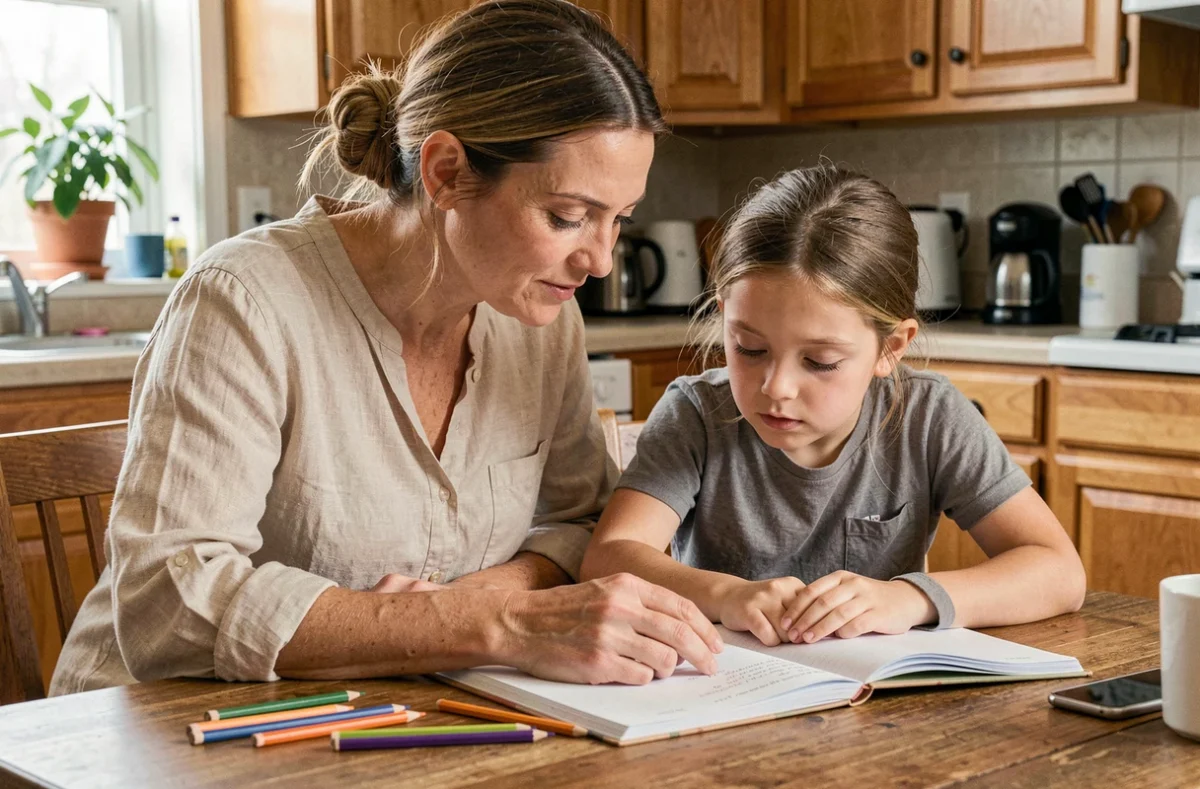
School support is the area where the boundary between support and over-control blurs the fastest. Homework help should not turn the parent into a substitute teacher. The parent’s role is limited to providing a conducive environment (quiet place, regular schedule, available materials) and reporting persistent difficulties to the educational team.
A child who encounters repeated blockages on the same type of exercise needs a professional diagnosis (speech therapist, school psychologist), not a more intense repetition of the same exercise at home. Insisting without appropriate training risks crystallizing the blockage and associating homework time with a lasting negative experience.
The most effective support solutions rely on regularity rather than duration. Fifteen minutes of daily shared reading or targeted revision yield more results than a marathon session on Sunday night. Regularity takes precedence over intensity in the development of learning.
Children’s education is neither a set of rules nor a single posture. What works is the ongoing adjustment: observe, name, frame, and then let go at the right moment. Parents who integrate this logic of gradual adaptation notice a decrease in daily conflicts and a child who gains autonomy, without requiring more time or a particular method.