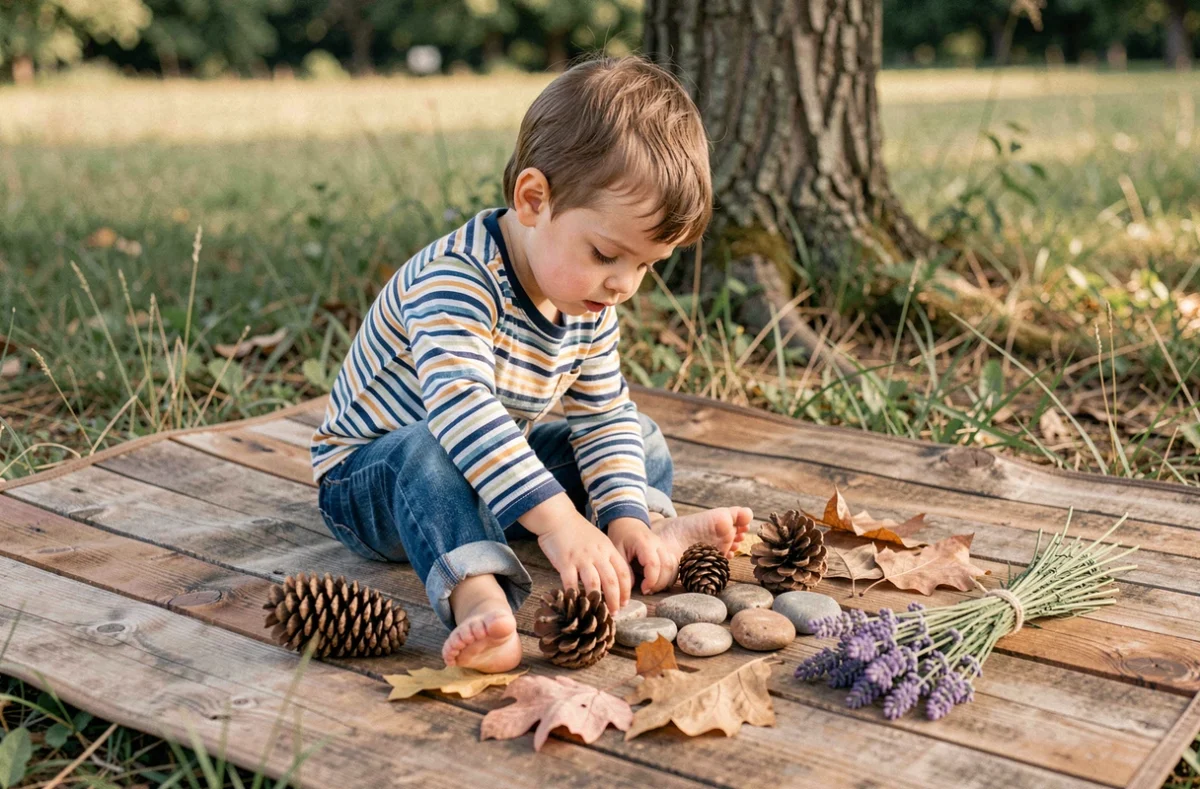
A fourteen-month-old child picks up a pine cone, turns it over, brings it to their mouth, then puts it down to pick up another. Repeated dozens of times, this action engages touch, sight, hand-to-mouth coordination and decision-making. Sensory exploration through nature begins with this raw curiosity, long before an adult names the activity.
Safety and free play in nature: managing the mouthing reflex in toddlers
Have you noticed that children under two explore almost everything with their mouths? This oral reflex is a sensory channel in its own right, not a behavior to correct. The real challenge is to provide a suitable play environment without putting a stop to this exploration.
In its 2025 review, Anses notes that poison control centers regularly record plant exposures among young children. The agency recommends keeping children away from toxic species and never letting them handle a plant whose identity is uncertain.
In practice, this means sorting natural materials before offering them. Smooth pebbles too large to swallow, pieces of oak or birch bark, open pine cones, hazel or linden leaves: these materials are suitable for free exploration. Berries, mushrooms, cherry laurel leaves and foxglove have no place in a sensory basket.
Specialist resources such as Petites Graines offer activities designed for this oral stage, using selected natural materials and clear supervision guidelines. The aim is not to sanitize contact with nature, but to carefully choose the materials while letting children explore freely.
- Remove any plant that has not been positively identified, even if it looks ordinary in a garden or park.
- Choose items larger than the child’s closed fist to reduce the risk of swallowing.
- Stay within arm’s reach during play, without interrupting exploratory actions unless there is an immediate danger.
Montessori sensory activities outdoors: real-world materials, not equipment
The Montessori approach for toddlers is based on a simple principle: children learn through direct experience, not demonstration. Outdoors, the ground, air, light and textures provide everything they need.
The natural sensory bin
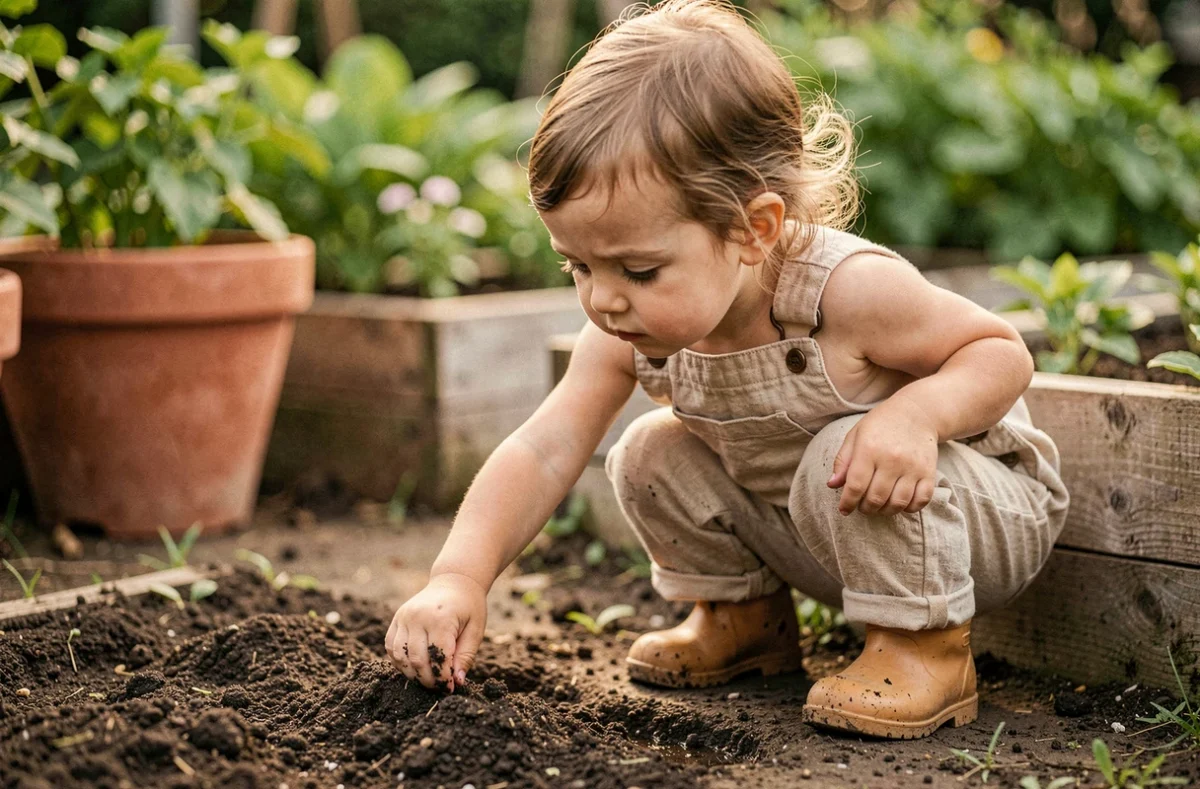
Fill a shallow bin with slightly damp soil, a few flat pebbles and short twigs. The child dips in their hands, scrapes, stacks and tips things over. Each texture prompts a different tactile response: the graininess of the soil, the smoothness of the pebble, the roughness of dry wood.
No instructions are needed. The adult observes and names what the child touches (“it’s rough,” “it’s cold”), stepping in only if a very small item is heading toward the child’s mouth.
Walking barefoot on different surfaces
Grass, sand, fine gravel, moss, packed earth: alternating surfaces underfoot stimulates proprioception, or the body’s awareness of its position in space. A child aged twelve to eighteen months walking barefoot on moss adjusts their balance differently than on gravel. The sole of the foot is one of the areas richest in tactile receptors.
For children who have only recently started walking, this activity also strengthens the muscles in their feet. A few meters is enough, on ground that has been checked for hazards (no broken glass or thorns).
Spread sensory discoveries throughout the day: WHO recommendations
The WHO guidelines published in 2019 state that children aged one to two need 180 minutes of physical activity per day, at any intensity, spread throughout the day. For infants, the guidelines recommend several periods of active play rather than one concentrated session.
In terms of sensory activities, this means that a ten-minute morning outing to touch wet leaves, fifteen minutes with a sensory bin after a nap and five minutes of barefoot walking before a snack are better than one hour-long “nature session.”
The National Quality Framework for Early Childhood Care, published in 2025, takes a similar approach. It identifies daily outings as a professional standard in group childcare, not an occasional activity. Going outside every day is part of the routine, not the program.
Free play in nature and child development: what the research really says
A systematic review of children aged two to twelve found recurring positive effects of free play in nature on physical activity and imaginative play. Children move more, invent more complex scenarios and interact with their surroundings for longer.
These findings are promising, but the research remains cautious. The studies reviewed use very different methods and measures. The conclusions do not constitute definitive proof for every type of sensory activity, or specifically for toddlers.
For parents and professionals, this means that offering free play in nature is consistent with the available evidence, but there is no guaranteed formula. Observing the child, noting what captures their attention, and adapting the duration and materials is an ongoing process of adjustment, not the application of a set protocol.
- A child who sits watching leaves move is exploring through their senses just as much as one who runs around and picks things up.
- Free play cannot be scheduled: it is made possible by a safe environment and an available adult.
- Changing locations (garden, park, woodland, riverbank) enriches sensory experiences without requiring any special effort.
Sensory exploration in nature requires neither special training nor expensive equipment. It calls for an adult who sorts the materials on offer, accepts the child’s slower pace and goes outside several times a day rather than just once. The mouthing reflex is not an obstacle; it is a signal: the child is exploring with the tools available to them. It is up to the adult to make that exploration possible and safe.