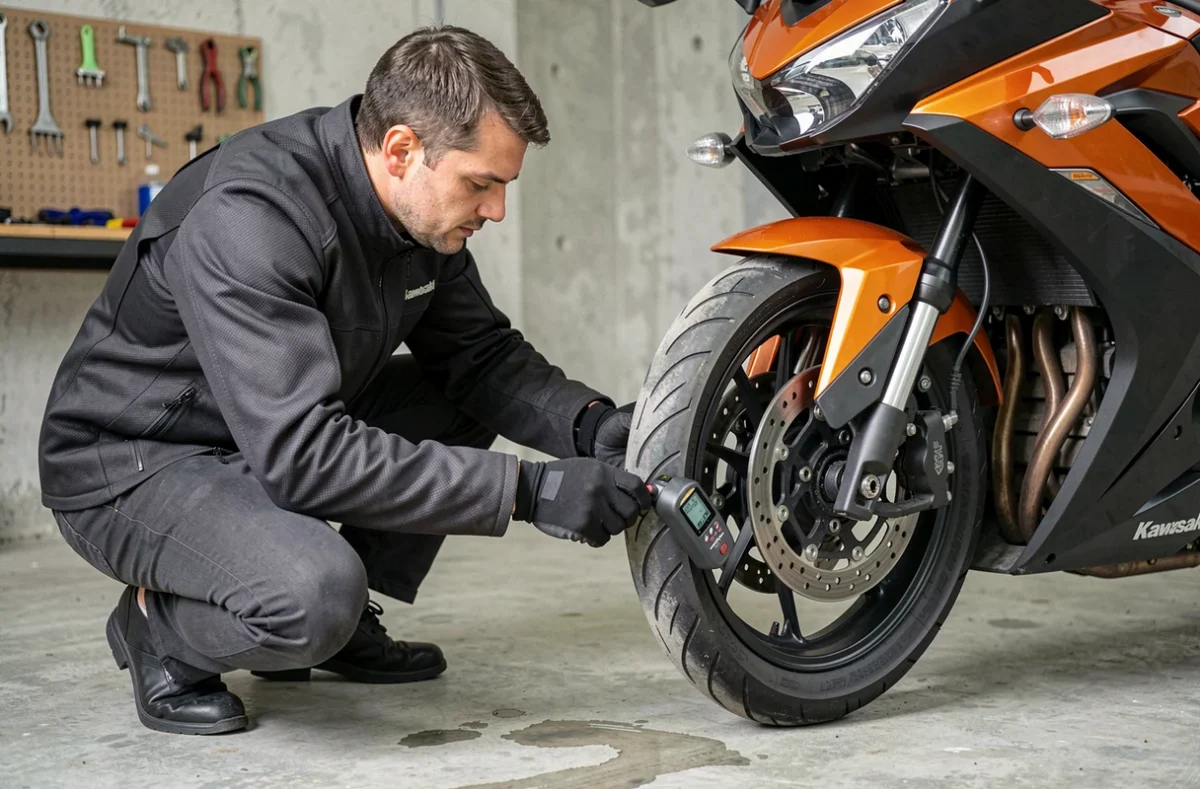
Checking the tire pressure on a Kawasaki ER6N seems simple: one pressure gauge, two valves, and two target readings. The challenge lies elsewhere—in the measurement conditions, the tools used, and how pressure differences are interpreted. Comparing Kawasaki’s recommended pressures with real-world checks highlights common mistakes that often go unnoticed.
ER6N front and rear tire pressure: differences between recommendations and common mistakes
| Configuration | Front tire (120/70 ZR17) | Rear tire (160/60 ZR17) |
|---|---|---|
| Rider only, everyday use | 2,2 bars | 2,5 bars |
| With passenger | 2,3 bars | 2,8 bars |
| Highway (journey of more than 2 hours) | +0,3 bar | +0,3 bar |
These pressures apply only when the tires are cold. The most common mistake is to inflate the tires just after a ride, then find the pressure is too high the next morning once the tires have returned to ambient temperature.
A detailed article on ER6N tire pressure explains that measuring pressure when the tires are hot consistently skews the result, sometimes by several tenths of a bar. Letting air out to correct the pressure while the tires are hot can leave them underinflated once they cool down.
According to Michelin, a tire is considered cold if it has not been ridden for at least two hours, or if it has traveled less than 3 km at low speed. Inflating your tires after arriving at a gas station following a 10 km ride does not meet this condition.
Pressure loss in cold weather or a slow leak: diagnosing the ER6N
When the outside temperature drops, tire pressure decreases as a matter of course. This physical phenomenon (the ideal gas law) does not indicate a fault. The practical question is whether the pressure loss is consistent with this normal temperature-related change or points to a slow leak.
Normal temperature-related change
A drop in ambient temperature causes tire pressure to decrease. Kawasaki does not recommend a specific winter tire pressure for the motorcycle. The target pressure remains the same in summer and winter, measured cold under the conditions at the time.
Arbitrarily adding 0,2 bar in winter (a practice sometimes suggested on forums) is not based on any manufacturer recommendation. If a cold reading in January shows 2,2 bars at the front, the tire is correctly inflated.
Slow leak or valve problem
Regular, repeated pressure loss between checks when the outside temperature is stable points to a mechanical problem. Three main causes are worth checking:
- A foreign object lodged in the tread (screw, nail, metal fragment) causing a tiny puncture and gradual air loss
- A damaged or loose valve, which can be identified by applying soapy water to the valve stem: bubbles indicate a leak at the valve
- A poor seal where the tire meets the rim, sometimes caused by corrosion or an impact on the rim edge
If pressure drops by more than one tenth of a bar per week at a constant temperature, a leak is likely. A visual inspection and a soapy-water test on the valves can quickly confirm the cause.
Pressure gauges and measurement conditions: biases riders overlook
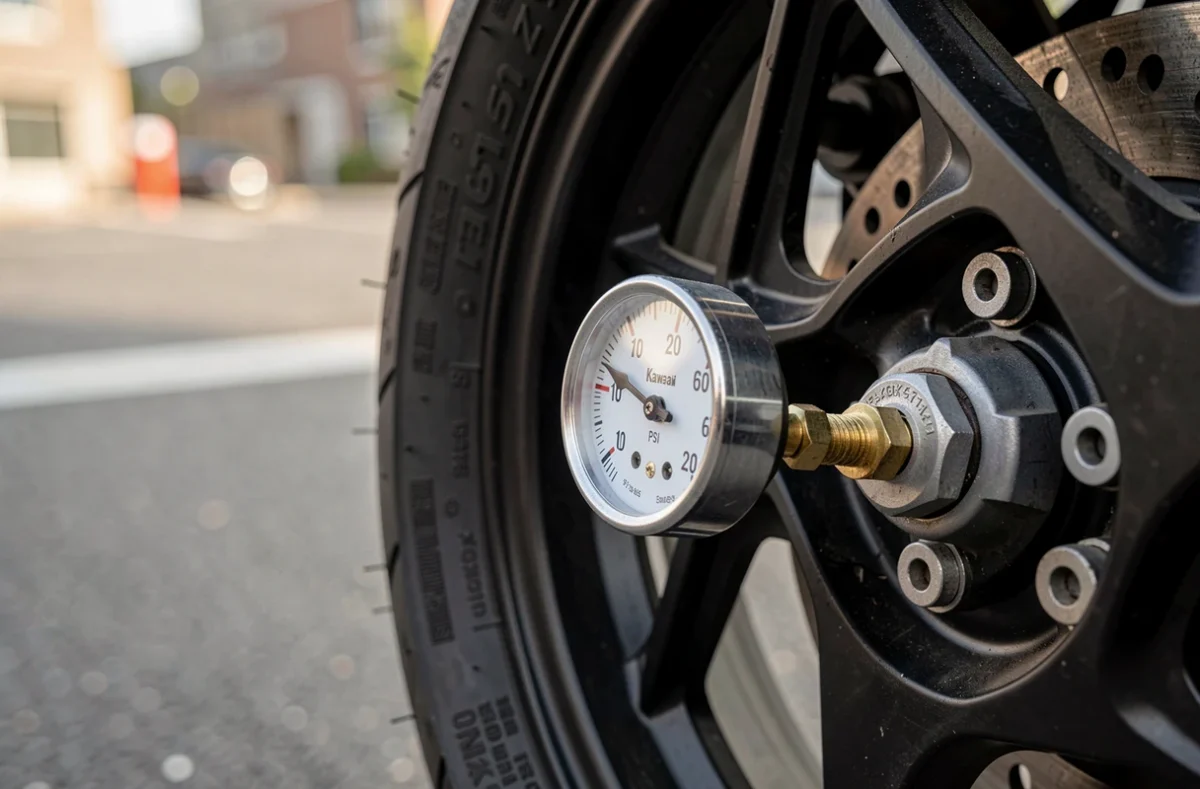
Pirelli recommends checking motorcycle tire pressure on a level surface with a properly calibrated pressure gauge. This detail has direct practical implications.
Self-service air pumps at gas stations use pressure gauges that see heavy use. Their accuracy deteriorates over time. A difference of 0,1 to 0,3 bar between two different gas station gauges is not unusual. Always inflating your tires at the same place with the same gauge can create a false sense of consistency if that gauge is itself inaccurate.
The most reliable solution is to own a good-quality pressure gauge and use it as your reference. Comparing its reading occasionally with a professional gauge (at a motorcycle workshop or inspection center) can reveal whether your own tool is inaccurate.
Common handling mistakes
- Pressing the valve to check “by ear” whether air is coming out: this releases air and skews the next reading
- Not screwing the valve cap back on after inflation, exposing the valve mechanism to dirt and accelerating wear
- Using a connector that does not fit the valve properly, causing air to escape during the measurement itself
Underinflation and overinflation on the ER6N: measurable effects
An underinflated tire flexes more on its sidewalls. The contact patch deforms, operating temperature rises, and wear becomes concentrated on the edges of the tread. On the ER6N, whose 160/60 rear tire handles most of the drive force, even moderate underinflation affects cornering stability.
An overinflated tire, by contrast, reduces the contact patch. Grip decreases, handling feels harsher in corners, and wear is concentrated in the center of the tire. The motorcycle transmits more road imperfections, making the rider more tired on long journeys.
Correct pressure alone does not guarantee adequate grip. Michelin notes that tires have an ideal operating temperature and recommends accelerating and braking gently in cold weather. On cold or wet roads, even with 2,2 bars at the front and 2,5 bars at the rear, take care during the first few kilometers while the rubber warms up.
Tire pressure can be checked, but it cannot overcome the physical limitations of the tire in poor conditions. Regular checks, a reliable pressure gauge, and measurements taken consistently when the tires are cold are the three requirements for making sure the readings are meaningful.